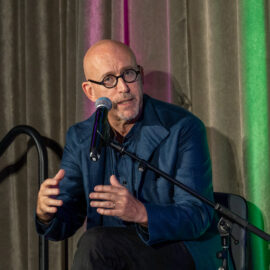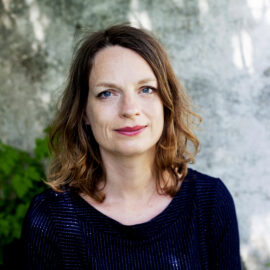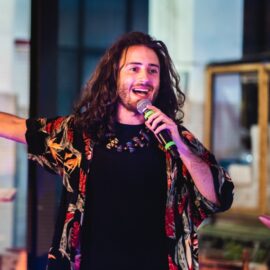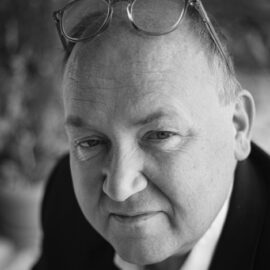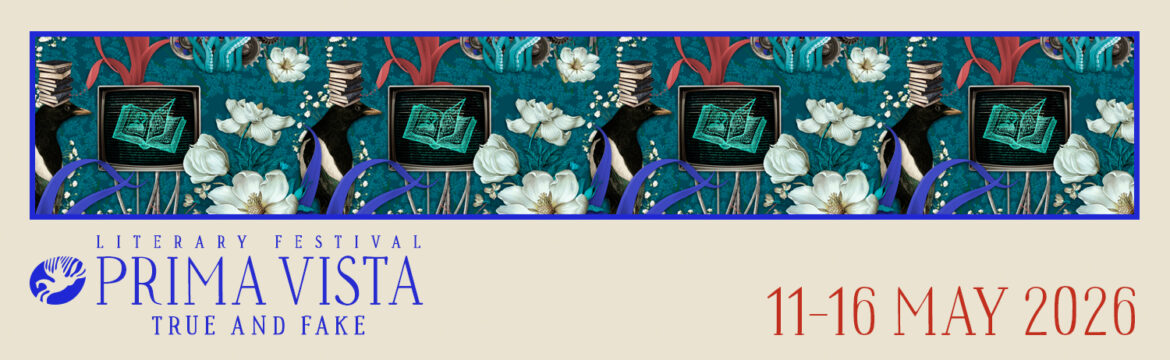
The international literary festival Prima Vista 2026 will take place in Tartu from 11 to 16 May. The festival’s theme is ‘True and Fake’. This year’s patron is the novelist and scholar Meelis Friedenthal, and the festival’s partner city is Viljandi.
The festival’s theme offers an opportunity to reflect on the borderlands between human beings and technology, nature and culture, reality and imagination. It will explore how artificial intelligence and artificial environments shape human identity and creativity, how literature helps to preserve human experience, the role of imagination in the formation of identity, and what cultural authenticity means in a contemporary context. The festival aims to foster a lively dialogue between creative practitioners from diverse backgrounds and audiences, and to offer new perspectives for understanding the rapidly changing world.
I am eating the soup of the day in a café and looking at the plastic plant in a tin pot on the table in front of me. These pots are on all tables here and I cannot say what plant it is they have tried to imitate. But it is green, with tiny leaves and at first glance, one may not notice at all it is plastic, but if you run your hand over it, lean closer, everything becomes quite clear.
That small fake plant has been meant to create a cozy homelike feeling and true, is not quite pointless. It marks aspiration and I understand the aspiration. The plant doesn’t need care or sunlight, nobody has to be responsible for it in person. If we wish, we can create some sequence of responsibility – the designer, the maker of the mould, the quality check at the factory, apparently somewhere in China, the swaying slowly in a container over land and sea, arriving finally at some shop, etc. All participants in that process are a bit responsible, which generally means very little.
But if we put a real plant in that pot, someone should come and water it, the café-goers might inadvertently pour some soup on it, the sunlight might not reach its leaves, and finally, it may happen that the plant will not survive such mistreatment and dies. The responsible party is right here.
It seems to me that the situation describes in short our choice between the true and the fake. Be it synthetic clothes, food colours or pictures and texts created by the generative AI. The fake will more or less do, it has naturally its shortcomings, but due to its convenience and cheapness, it sometimes also has clear advantages, and the very same convenience and cheapness will generally outweigh all other arguments, there is so much to do anyway, one cannot be responsible for everything. It seems that way. Or does it?
These are the hesitations we would like to find some solution to during this year’s Prima Vista. Why seek decaying and delicate things? Why take responsibility for your text? Why grow it like a plant? Why give up convenience and practicality, optimised and effective solutions? Is there altogether an antithesis? Is alchemic gold less gold than the real one, a homunculus less than the true human being?
Meelis Friedenthal,
Patron of Prima Vista 2026
Translated by Kersti Unt
News
International guests